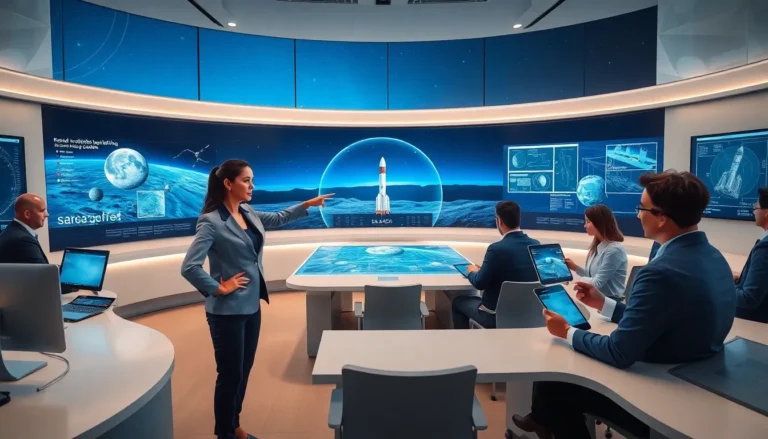
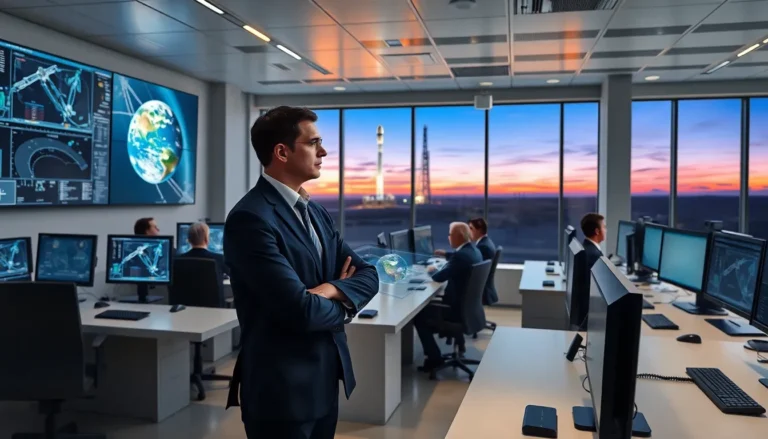
Space technology ideas are transforming how humans explore and use the cosmos. From reusable rockets to orbital debris cleanup, these innovations push boundaries once thought impossible. Engineers, scientists, and private companies now collaborate on projects that could establish permanent human presence beyond Earth. This article examines the most promising space technology ideas driving progress in 2025 and beyond. Each concept addresses specific challenges, cost, sustainability, connectivity, and survival, that define the next era of space exploration.
Table of Contents
ToggleKey Takeaways
- Reusable rockets like SpaceX’s Falcon 9 cut launch costs by approximately 30%, making ambitious space technology ideas like lunar bases and Mars colonies financially viable.
- Satellite constellations in low Earth orbit provide global internet with latency as low as 20-40 milliseconds, connecting billions of people in remote and underserved areas.
- Space debris removal is an urgent priority, with the market projected to reach $2.9 billion by 2030 as companies develop robotic arms, nets, and magnetic capture systems.
- Lunar and Martian habitat technologies include 3D-printed structures, inflatable modules, and underground lava tubes to protect crews from extreme temperatures and radiation.
- In-space manufacturing and resource utilization will transform exploration by mining lunar water ice for fuel and oxygen, reducing dependence on costly Earth resupply missions.
- These space technology ideas shift humanity’s approach to the cosmos—treating space as a place to live and work rather than just visit.
Reusable Rockets and Sustainable Launch Systems
Reusable rockets represent one of the most impactful space technology ideas of the past decade. Traditional rockets were single-use vehicles. Each launch destroyed millions of dollars in hardware. SpaceX changed this equation with its Falcon 9 boosters, which land vertically and fly again.
The economic impact is significant. A new Falcon 9 costs roughly $67 million. Reusing the first stage cuts launch costs by approximately 30%. Blue Origin’s New Glenn and Rocket Lab’s Neutron follow similar philosophies. These companies bet that lower costs will open space to more customers.
Sustainability extends beyond reuse. Engineers are developing greener propellants. Methane-oxygen combinations burn cleaner than traditional kerosene fuels. Some startups experiment with bio-derived fuels that reduce carbon emissions during launch.
Fully reusable spacecraft like SpaceX’s Starship aim to reduce per-kilogram launch costs below $100. Current costs hover around $2,700 per kilogram on Falcon 9. This price drop would make ambitious missions, lunar bases, Mars colonies, space hotels, financially viable.
Reusable launch systems also enable higher flight rates. A rocket that launches monthly instead of yearly accelerates testing, iteration, and deployment. This pace supports the rapid growth of satellite constellations and space infrastructure projects.
Satellite Constellations for Global Connectivity
Satellite constellations rank among the most commercially successful space technology ideas today. Companies deploy thousands of small satellites in low Earth orbit (LEO) to provide internet access worldwide.
SpaceX’s Starlink leads the market with over 6,000 satellites operational as of late 2024. Amazon’s Project Kuiper plans to launch 3,236 satellites. OneWeb, now part of Eutelsat, operates roughly 600 satellites. Together, these constellations aim to connect billions of people without reliable internet.
LEO satellites orbit at altitudes between 340 and 1,200 kilometers. This proximity reduces signal latency to 20-40 milliseconds, comparable to ground-based fiber networks. Traditional geostationary satellites sit 35,786 kilometers away, creating delays of 600+ milliseconds.
The technology serves multiple sectors. Remote villages gain internet access. Maritime vessels stay connected across oceans. Airlines offer in-flight Wi-Fi without interruption. Military operations use secure satellite links in contested areas.
But, constellations create challenges. More satellites mean more collision risks. Light pollution affects astronomical observations. Frequencies become crowded. Engineers must balance connectivity gains against these concerns.
Inter-satellite laser links represent a key advancement. These optical connections let satellites relay data without ground stations. Starlink uses this technology to reduce latency further and extend coverage to polar regions.
Space Debris Removal and Orbital Sustainability
Space debris removal has become an urgent priority among space technology ideas. Over 36,500 objects larger than 10 centimeters orbit Earth. Millions of smaller fragments also pose collision threats.
The Kessler Syndrome describes a worst-case scenario. Collisions generate debris, which causes more collisions, which generates more debris. This cascade could render certain orbits unusable for decades.
Several companies develop active debris removal (ADR) solutions. Astroscale’s ADRAS-J mission demonstrated close-approach inspection of debris in 2024. ClearSpace-1, funded by the European Space Agency, plans to capture and deorbit a defunct payload adapter in 2026.
Removal methods vary. Some spacecraft use robotic arms to grab debris. Others deploy nets or harpoons. Magnetic capture systems target objects with ferrous components. Each approach suits different debris types and orbital conditions.
Prevention matters as much as cleanup. New satellites now include deorbit capabilities. Regulations require operators to remove spacecraft within 25 years of mission end. Some propose reducing this to five years.
Tracking systems improve constantly. Ground-based radar and optical telescopes monitor debris. Space-based sensors provide additional data. Better tracking enables collision avoidance maneuvers and safer operations.
Space debris removal represents both a technical challenge and a business opportunity. The market could reach $2.9 billion by 2030 as operators seek to protect valuable orbital assets.
Lunar and Martian Habitat Technologies
Habitat technologies for the Moon and Mars stand out among ambitious space technology ideas. NASA’s Artemis program aims to establish a sustained human presence on the lunar surface. Private companies plan Mars settlements within the next two decades.
Lunar habitats face specific challenges. Temperatures swing from 127°C during the day to -173°C at night. Radiation from solar flares and cosmic rays threatens crews. Micrometeorites strike the surface constantly. Dust clings to everything and damages equipment.
Engineers propose several solutions. Inflatable modules offer lightweight, expandable living spaces. ICON, a construction technology company, develops 3D-printed structures using lunar regolith, the rocky soil covering the Moon’s surface. Underground lava tubes could shelter habitats from radiation and temperature extremes.
Martian habitats require different approaches. The thin atmosphere provides some radiation shielding but little protection from cold. Average surface temperatures hover around -60°C. Dust storms last for months.
NASA’s Mars Ice Home concept uses water ice as both radiation shielding and a potential resource. SpaceX envisions pressurized domes connected by tunnels. Some researchers suggest terraforming portions of Mars over centuries, though this remains speculative.
Life support systems prove critical for both destinations. Closed-loop systems recycle water, air, and waste. Plants could provide food and oxygen while improving crew morale. NASA tests these technologies aboard the International Space Station.
These space technology ideas build toward self-sustaining settlements that reduce dependence on Earth resupply missions.
In-Space Manufacturing and Resource Utilization
In-space manufacturing and resource utilization represent transformative space technology ideas. Instead of launching everything from Earth, future missions will build and supply themselves using materials found in space.
In-space resource utilization (ISRU) starts with water. The Moon’s polar craters contain water ice. This ice can produce drinking water, breathable oxygen, and hydrogen-oxygen rocket fuel. Mining lunar water would dramatically reduce mission costs and enable deeper exploration.
Asteroids offer another resource frontier. Some near-Earth asteroids contain platinum, nickel, cobalt, and rare earth elements. A single 500-meter asteroid could hold more platinum than all Earth’s historical production. Companies like AstroForge and TransAstra pursue asteroid mining technologies.
Manufacturing in microgravity enables products impossible to make on Earth. ZBLAN optical fiber, produced in space, has fewer impurities than terrestrial versions. Protein crystals grow larger and more uniformly, aiding pharmaceutical research. 3D-printed organs could benefit from zero-gravity conditions.
Space-based solar power presents another opportunity. Satellites could collect sunlight 24/7 without atmospheric interference. They would beam energy to Earth via microwaves or lasers. Japan, China, and the European Space Agency fund research into this concept.
On-orbit servicing, assembly, and manufacturing (OSAM) extends satellite lifespans and enables large structure construction. Robots could assemble massive telescopes, solar arrays, or spacecraft too large to launch whole.
These space technology ideas shift the economics of space. Earth becomes a starting point rather than a permanent supply depot. Humanity begins treating space as a place to live and work, not just visit.